
Searching Washington Court Dockets
A case number or party name can be unclear. Washington Courts Case Search is the best first stop. Pick the court level that matches your papers, then run the index query. A hit can point you toward a court and sometimes a fuller local record. It is not the official file, though. The County Clerk holds the Superior Court case record. District and Municipal Court clerks keep their own registers. A full docket search in Washington usually takes two steps. Find the case statewide, then contact the court that holds the file.
Use the venue printed on the citation or order. Is it missing? Search by name and filing year. Then contact that clerk or portal.
- Open Washington Courts Case Search and choose District and Municipal, Superior, or Appellate Court.
- Select name, case number or business name search, then choose the court and case type where those fields appear.
- Use the result to identify the filing court. For a fuller Washington Superior register, check Odyssey only if that court participates.
- Read the local register for filings, settings and disposition events. Open the underlying order or pleading if its terms matter.
- Ask the court clerk for a certified copy or a record that is absent online. Use the Washington county directory to reach the right county site.
Washington Case Search Fields
The statewide form splits court level from search type. You must choose a District and Municipal, Superior, or Appellate tab before picking how to search. The options include person, case number, or business name. The trial-court form asks for the specific court and case type. There is no county-only dropdown. Washington's venue list covers individual Superior Courts. It also includes a long menu of District and Municipal courts. Pick the named court itself. A city label and a county label are not always interchangeable in Washington.
| Field | What It Accepts | Search Note |
|---|---|---|
| Court level | Washington District/Municipal, Superior, or Appellate | Choose the level shown on the case papers. |
| Search type | Washington name, case number, or business name | The Washington form changes fields to fit the selected type. |
| Court name | Individual Washington court selector | Required for the selected court search; no separate county field appears. |
| Case type | Superior: Civil, Criminal, Domestic, Probate/Guardianship. Lower court: civil, criminal, infractions, probable cause, or small claim. | Not every type belongs in each court tier. |
| Year filed in/after | Washington selector range, 1975 through 2026 when inspected | It narrows filing date, not a promise of archive coverage. |
| Name or number | First and last name, business name, or the exact Washington case number | Local number formats differ; copy punctuation from court papers. |
| CAPTCHA | “I’m not a robot” check | Required by Washington’s public form before submission. |
According to Washington Courts, the public index refreshes within 24 hours after clerk data entry. Fields can differ from court to court. The general search result does not deliver case documents.
Note: The year selector is a search filter, not a guarantee that every Washington court’s older paper archive has been converted to an online record.
Inside the Washington Statewide Case Search
Washington Courts Case Search is a free locator spanning municipal, district, Superior, and appellate cases. Court clerks enter the data, and the public database refreshes within 24 hours. Results can list a case number, filing date, case type, location, and party name. Some also carry a link to a detailed local portal. That reach makes the Washington index handy when you do not know the court. Still, it is a summary layer, not one all-courts docket.
The Washington State Administrative Office of the Courts (AOC) runs the Judicial Information System. It publishes the public search. AOC says plainly that a result is not the official court record. It may be incomplete, out of date, or insufficient to confirm a case outcome. Treat the result as a pointer to the next keeper of the file. That keeper is the court clerk.
Washington Cases Missing from Search
A blank result can mean several things. The search fields may be off. The local system may differ, or a reporting delay may exist. Sealing or another access rule may block the entry. Juvenile offender information stays out of publicly accessible statewide indexes. A sealed case may show only limited docket details. A sealed document can stay hidden even when the case itself appears. Odyssey has its own boundary: it covers participating Superior Courts, not King or Pierce Superior Court, and no District or Municipal Court cases.
If a Washington result comes up empty, double-check court level, venue, case number, and year. Try the court portal where one exists. Then ask the clerk whether the file is public, archived, or restricted. A missing index entry does not prove the case or filing never existed.
A missing statewide result is a routing clue. Confirm the court and venue with the local clerk before drawing a conclusion about the case record.
Note: A missing match can reflect court coverage, record restrictions or a name-format issue, so verify with the venue clerk first.
Which Washington Courts Keep Dockets
Washington sits its appellate tier above the trial courts. Superior Court is the general-jurisdiction trial court. The state's 39 counties form 32 judicial districts. County Clerks keep the Superior Court case files. District Courts and Municipal Courts hold limited jurisdiction. Each keeps its own dockets through local clerks. Juvenile Court is a division of Superior Court, not a separate level in the statewide hierarchy.
| Court | Common Docket Matters | Starting Search Route |
|---|---|---|
| Washington Superior Court | Felonies, general civil matters, family, probate, guardianship and juvenile cases | Washington Case Search, then Odyssey in 37 counties or the local portal and County Clerk |
| Washington District Court | Misdemeanors, infractions, small claims, limited civil matters and felony preliminary hearings | Washington Case Search, local court portal, JIS-Link or District Court Clerk |
| Washington Municipal Court | City or town ordinance cases, misdemeanors and infractions within its jurisdiction | Washington Case Search or local Municipal Court Clerk |
| Washington Court of Appeals | Appeals from trial court orders and judgments | Washington appellate case search and public document portal |
| Washington Supreme Court | Cases accepted for review by the state’s highest court | Washington Supreme Court case search and appellate clerk |
Civil authority overlaps across Washington's trial courts. A case label alone may not reveal who keeps the record. The amount in dispute, the relief sought, the subject, and local court assignment all matter. After an appeal, a separate Washington appellate number can appear. Keep trial and appellate searches apart.
Note: Court level, not the broad case label alone, tells a Washington reader which clerk maintains the controlling register.
Washington’s 37-County Odyssey Portal
The Odyssey Portal gives Washington a fuller Superior Court register across 37 counties. Anyone can view case information anonymously. Documents are different. They require registration and a Clerk-authorized access role, and display depends on local use of Odyssey Document Management. The portal is not an all-state file store. King and Pierce Superior Courts sit outside its county scope. No District or Municipal Courts are included.
| System | Washington Coverage | What to Expect |
|---|---|---|
| Washington Odyssey Portal | 37 Washington county Superior Courts | Case information and Register of Actions; document access varies by role and county setup. |
| King County Clerk portal | Washington King County Superior Court | Separate Clerk-managed record system. |
| Pierce County LINX | Washington Pierce County Superior Court | Separate county portal and record route. |
| Local court / JIS-Link | Washington District and Municipal Courts | Odyssey does not cover limited-jurisdiction dockets; JIS-Link is a paid case-information service with no document images. |
Local courts also choose their own case-management and filing tools. General Rule 30 sets the standards for electronic filing and service, though each court decides whether and how to accept or require e-filing. The statewide index ties some case data together without forcing every county onto one vendor.
What a Washington Court Docket Shows
A Washington docket ties a case to its events. It connects the case identity to hearings, filings and court orders, though how much you see depends on the court's public system. The statewide index may carry only basic identifying data. Odyssey's own training guide breaks its screens into Case Information, Party, Disposition Events, Events and Hearings, Register of Actions and Documents areas. One caution: a docket line can point to a filing without showing the paper itself.
| Case number | Use the exact Washington court-assigned number. Odyssey and older JIS/SCOMIS patterns differ, so do not decode another court’s number from a sample. |
|---|---|
| Parties | Names and roles shown in a Washington public case view; confidential or restricted matters may be excluded. |
| Filing and event list | A dated Washington case record of filings or procedural events. The associated complaint, motion, order or exhibit is a separate document. |
| Hearing setting | Washington calendar details can include court location, hearing type, date and time, judge or courtroom when that portal displays them. |
| Disposition | A local case outcome field or event. Washington Case Search does not certify an outcome; read the local order or judgment. |
Number formats can hint at age. An Odyssey number like 15-1-80304-21 follows a documented county-code pattern, while an older SCOMIS number may end in a single check digit. Treat both as clues only. The Washington court that assigned the case number remains the reliable guide.
Washington Docket Terms and Codes
Labels shift across Washington's public search products. Odyssey calls its chronological event list a Register of Actions. JIS-Link, meanwhile, describes a case docket. AOC's code manuals define JIS fields for participating limited-jurisdiction courts. They do not cover every county's newer case system. Always read the field label before you interpret an abbreviation.
- Register of Actions
- Washington Odyssey’s name for the chronological case events and filings.
- Case docket
- JIS-Link’s Washington label for case and docket information in connected courts.
- Case disposition
- In Washington, a case-level status or result; it is distinct from a judgment type or signed judgment.
- ARR
- Washington JIS hearing code for arraignment in courts using that code set.
- CONTD
- Washington JIS docket text indicating a continued event; check the newest entry for the current date.
- DJ
- Washington JIS civil judgment type for default judgment, not a substitute for the filed judgment document.
The Washington JIS guide lists docket, hearing, plea, disposition and judgment codes. For entries from another case system, local clerks can explain what they mean.
Washington Court Docket Volume
Washington's published 2025 caseload reports reveal a sharp split in trial-court work. Superior Courts recorded 195,288 filings. These were spread across criminal, civil, domestic, probate, adoption, mental-health and juvenile categories. Courts of Limited Jurisdiction recorded 1,412,434 filings. Traffic infractions and parking cases were in the mix. Remember what these figures are: filing totals grouped by court and case category. They are not a count of unique people, nor a statewide person-history database.
The split explains why Washington traffic tickets, small claims, felonies and family matters land in different tiers. It also separates their search routes. Routine parking and traffic matters stay in limited-jurisdiction courts. Superior Court takes the felony, major civil, family, probate and juvenile work. A big total does not promise that every case sits in the same portal. Nor does it promise that every entry is a final ruling.
The AOC 2025 Superior Court report breaks those Washington filings down by county and case type.
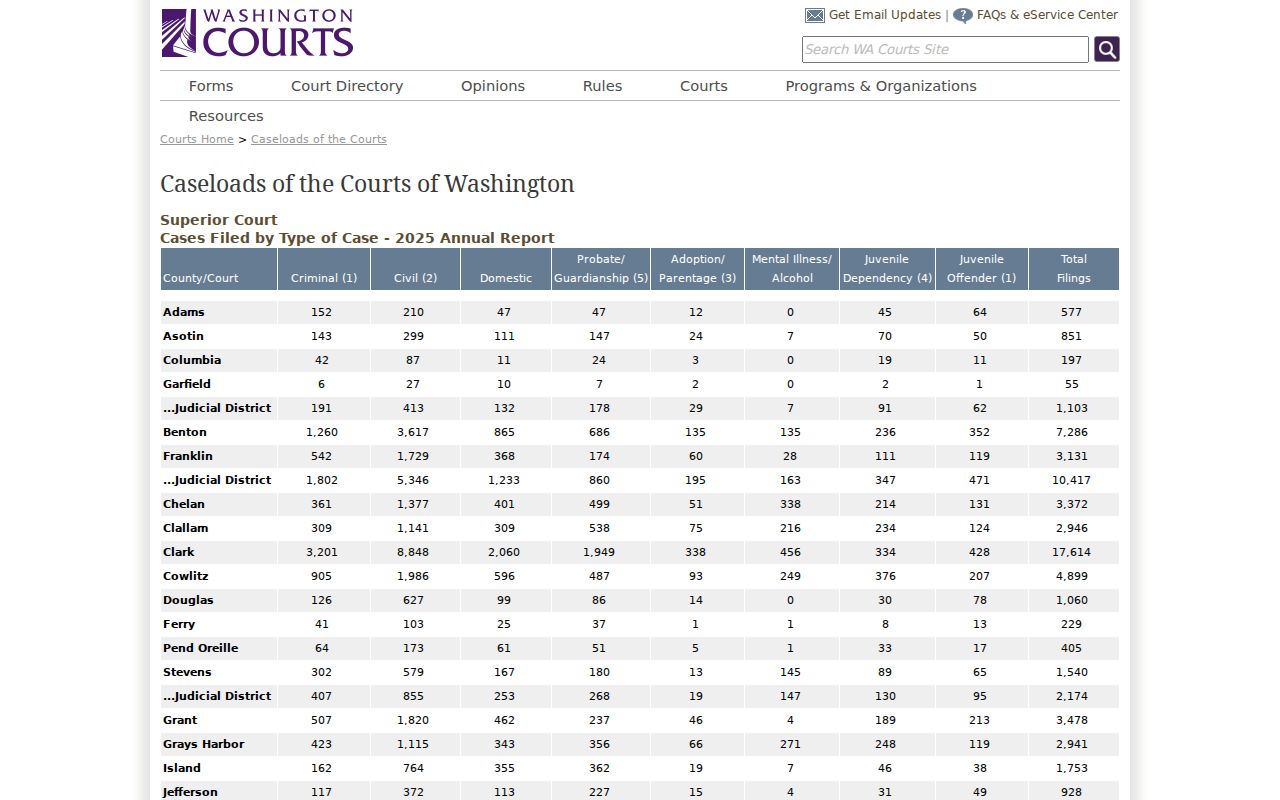
The AOC notes category changes and reporting limits, so compare years only with the report's own definitions. Its figures measure system workload, not any particular case's status.
The 2025 Courts of Limited Jurisdiction report details District and Municipal filings, including traffic infractions and parking cases.
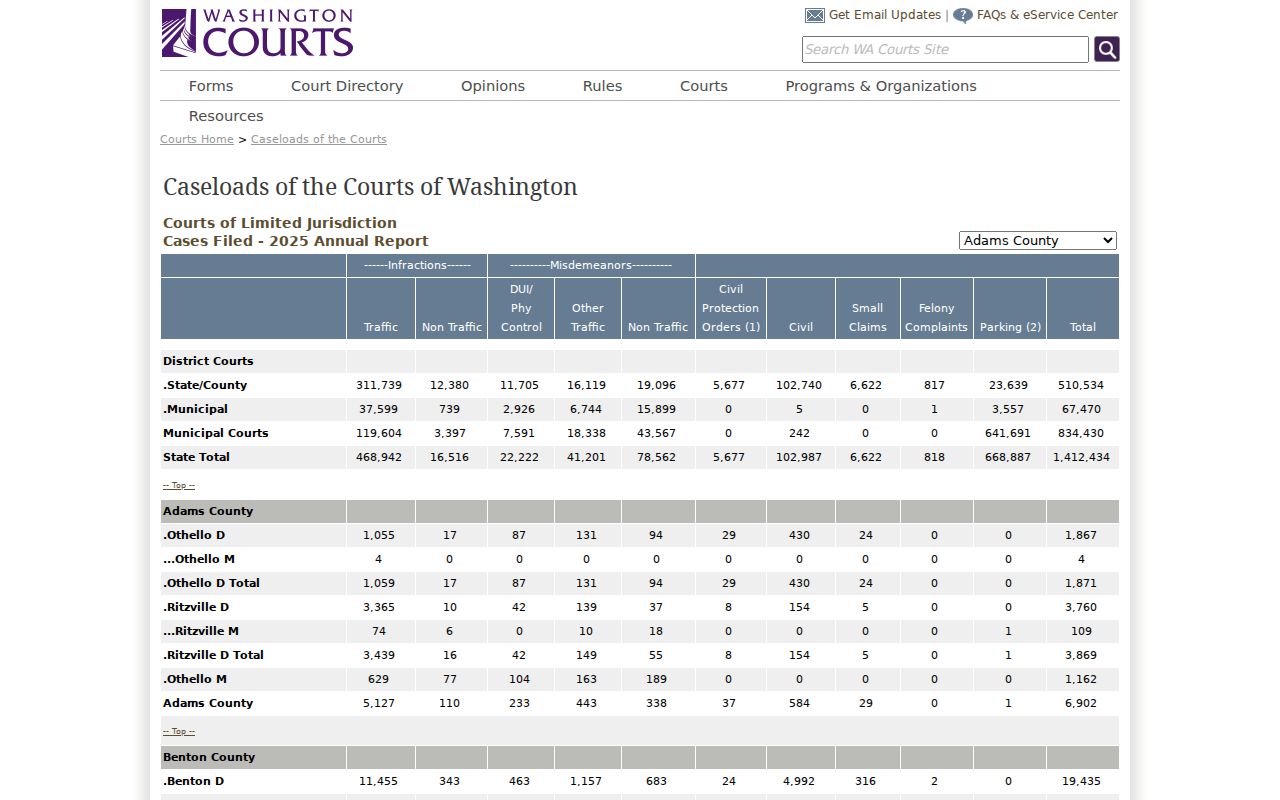
Its categories explain why Washington traffic and small-claims matters travel a different docket path than Superior Court cases.
Washington Public Access to Dockets
Court-access rules, not just the state agency records law, govern Washington court records. General Rule 31 treats indexes, calendars, dockets, orders and judgments as court records. It guarantees courthouse viewing with no viewing fee. The Washington Public Records Act, chapter 42.56 RCW, generally covers state and local agency records instead. Judicial administrative records follow a separate request path apart from case files.
Public access has limits. A clerk can hand over only what law, rule or court order allows. Case-file copies and certified records come from the court of record. A public search result is not an official document.
Washington access rules:
Washington GR 31 sets access to court records and courthouse viewing.
Washington GR 15 governs sealing, redaction and unsealing.
Washington GR 22 defines restricted family, protection-order, guardianship and therapeutic-court records.
Washington RCW 42.56 is the Public Records Act for agency records.
Washington Docket Entries and Restricted Files
A Washington case can sit in the public index while one of its filings stays sealed. GR 15 lets a court seal a whole file or particular documents after the required findings. When only a document is sealed, limited docket metadata may remain visible. Redaction is preferred when it protects the needed information without closing the full record.
Juvenile offender information stays off the public Washington statewide index under GR 31 and JISC policy. That policy does not settle what a clerk's office may let you inspect under the juvenile-record rules. GR 22 separately limits listed family, health, financial and treatment materials. When a Washington case is visible but shows no document link, ask the local clerk which access rule applies.
Parties must omit or redact certain personal identifiers from public filings. These include full Social Security, financial-account and driver-license numbers. An index result never opens a protected attachment. The clerk of the Washington court holding the file can explain the public portion, any court order and the request route.
Note: A public case entry does not make its sealed attachments, treatment records or protected juvenile information public.
Court Dockets by County in Washington
County clerks hold the Washington Superior Court file. District and Municipal Court clerks keep the records for their own courts. The statewide index helps you identify the right court. But a full Washington docket, current calendar detail or certified copy may still require the local system. These metro gateways highlight different Washington Superior Court routes. They also link to each county's docket site.
King County
Seattle · Largest population center; separate Superior Court Clerk portal.
Pierce County
Tacoma · Major south Puget Sound court system using LINX.
Snohomish County
Everett · North Puget Sound metro and Odyssey Superior Court.
Spokane County
Spokane · Eastern Washington’s largest metro and Odyssey Superior Court.
Clark County
Vancouver · Southwest Washington metro and Odyssey Superior Court.
Thurston County
Olympia · State-capital region and Odyssey Superior Court.
Need a Washington court docket for a specific case? Open the directory of all 39 Washington counties and pick the county where the filing happened.
Washington Appellate Docket Search
An appeal opens a brand new docket in Washington. The Court of Appeals hears the first round. It is split into three divisions. The Supreme Court stands above it as the court of last resort. Filing a notice of appeal in a Superior Court file does not carry over the old case number. The appellate clerk assigns a fresh one and keeps its own set of filings and docket entries.
For electronic copies, the Washington Appellate Court Public Document Portal is the free public option. It covers appellate cases filed from January 1, 2020 forward. The Supreme Court and each division of the Court of Appeals have separate search pages. You need the appellate case number to use them. Sealed and confidential records stay out. The portal will not show the trial court docket underneath the appeal.
Older appellate records, restricted documents, and certified trial court items all go through the clerk of the court that holds them. So a Washington case can leave a trail of two registers. One sits at Superior Court and one on appeal, each kept by its own clerk.
Note: A notice filed in the trial court is not the appellate docket; search the new appellate cause number separately.
Washington Court Technology and History
Washington court records have moved through several distinct eras. The state constitution created the judiciary in 1889. A century later, in 1969, the Court of Appeals arrived after a constitutional change relieved pressure on the Supreme Court docket. The Administrative Office of the Courts, formed in 1957, built the statewide information work that became JIS. AOC reports putting ACORDS and SCOMIS in place in 1976. Those systems let courts track records centrally while County Clerks kept the actual trial files.
Public access tools arrived in waves. Find Your Court Date came first, in 2002, listing future District and Municipal appearances. The Odyssey Superior Court project then ran from 2010 through 2018 and reached 37 counties. King and Pierce, though, stayed on separate systems. Appellate documents became official electronically in 2021. A free appellate document portal followed in 2022.
Newer changes add context rather than a new case search. AOC launched its Dashboard Reporting Tool in August 2025 with court workload statistics. In October 2025, Self-Help Washington brought statewide court-process information online. The GR 30 e-filing amendment took effect September 1, 2026. Each local court still decides which filing methods it accepts.
The Washington Courts homepage is the statewide front door. It carries material on court levels, rules, and every local court in the state.
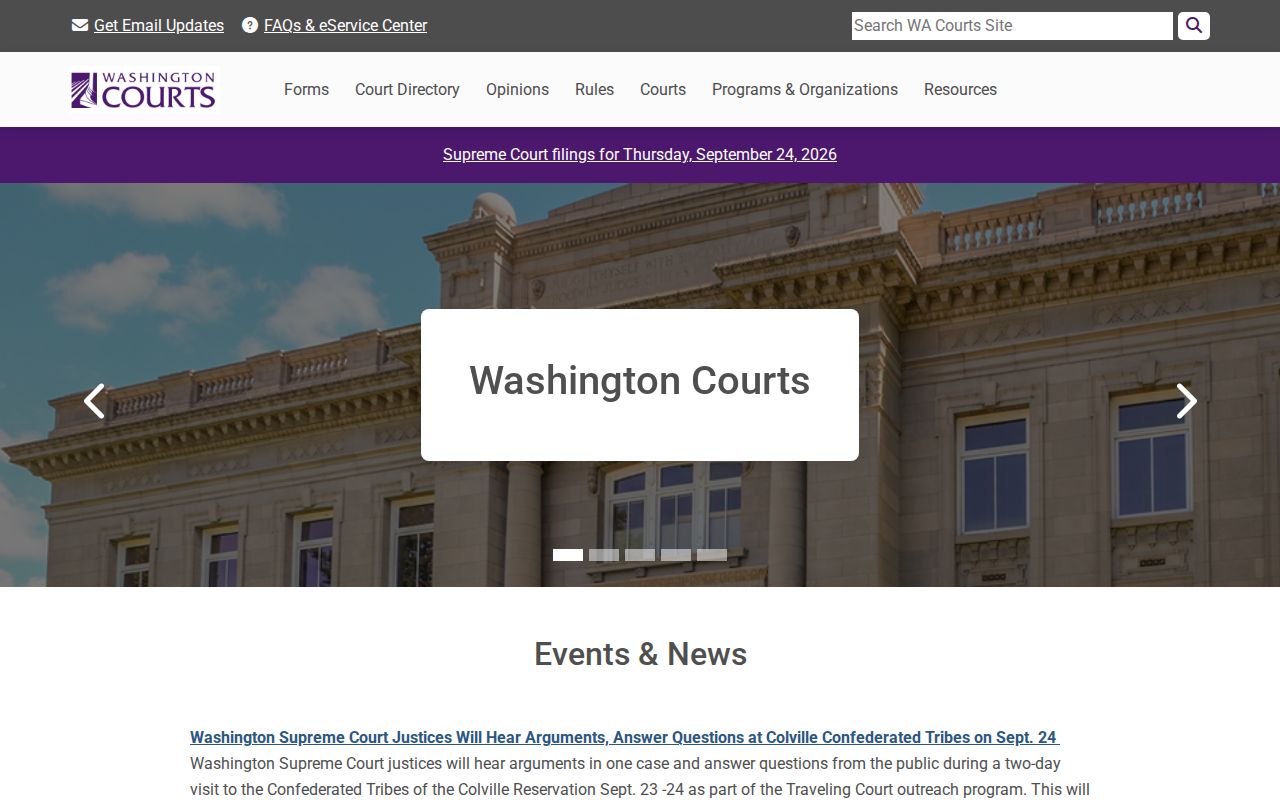
From the statewide masthead you can reach court services and AOC resources. The official case file for any single Washington matter, though, still sits with the trial clerk.