
Searching Criminal Dockets in Washington
The first stop for a Washington criminal case lookup is Washington Courts Case Search. It is the statewide public index. Pick a court level and a named court first. Then set a criminal case type and a filing-year floor. Add whatever name or number the form asks for. A case number saves time when a name is common or the spelling is unclear. Start with the court named on the papers. A felony can leave an early entry in a limited-jurisdiction court. A separate Superior Court file opens later.
One limit matters here. The Washington index can identify a case. Yet it may show none of the full register, charging paper, bond order, or sentence. The County Clerk holds the official Superior Court file. District and Municipal Court clerks keep their own records. A brief or blank result means you should try the court's local channel. The Washington county directory links to county-level court information for that next step.
- Identify the Washington court and venue from the notice or case papers.
- Open Washington Courts Case Search and select the court level and criminal case type.
- Search by the exact case number when available, or enter the required name and filing-year details.
- Use the Washington county directory to reach the local court channel for a full register or missing result.
- Ask the clerk that keeps the file for a specific document or certified copy.
Washington Criminal Court Levels
Court level decides where a Washington criminal docket lives. Felonies belong in Superior Court. This holds even when a District Court first records probable cause or a felony complaint. Most misdemeanors and gross misdemeanors stay at the lower level. Charges under state or county law generally go to District Court. City or town ordinance charges may land in Municipal Court. Juvenile offender cases sit in the Superior Court juvenile division, with added access limits attached.
Case numbers can differ across those Washington court files. After a felony transfer, you may need two records. One is the early limited-court record. The other is the new Superior Court case. A traffic infraction is civil, a different record class from a criminal traffic charge. Appeals create a separate appellate docket of their own. Knowing this structure helps when you compare results across portals.
| Washington Court | Criminal docket role | Record keeper |
|---|---|---|
| Washington Superior Court | Felony prosecution and juvenile offender matters | County Clerk / Superior Court Clerk |
| Washington District Court | Misdemeanors, gross misdemeanors, and some felony preliminary matters | District Court Clerk |
| Washington Municipal Court | Local ordinance misdemeanors and other matters assigned to the city court | Municipal Court Clerk or contracted clerk |
What a Washington Criminal Docket Shows
A Washington criminal docket records filings, settings, and actions in a case. The statewide index carries basic identifying information. A local Washington register may hold more detail. Odyssey splits its display into sections. They are Case Information, Party, Disposition Events, Events and Hearings, Register of Actions, and Documents. Those portal labels name the parts of a record. They do not promise that every Washington county displays every field the same way.
| Case number | Use the Washington court identifier. An AOC Odyssey example is 15-1-80304-21; older systems can use another ending. |
|---|---|
| Court and case type | Shows court location and a broad classification such as criminal, not a final finding. |
| Party and charge | Party roles and Washington charging papers identify the case; the exact charge may require the complaint or information. |
| Events and settings | Lists dated Washington hearings, filings, and orders when the local system makes them available. |
| Disposition | Records an outcome or procedural event. Check the Washington judgment or local register for the verified result. |
A docket line that names a filing is not the filed paper itself. Washington Courts Case Search does not provide outcomes, and the details of a charge, a release, or a sentence may sit in a document the local clerk holds. Treat a Washington index result as a path to the official court file, never a substitute for it.
Washington JIS Criminal Codes
Washington's Judicial Information System (JIS) publishes code references for courts of limited jurisdiction. The manuals define case types, docket entries, hearing types, and findings. These appear in JIS screens and workflow. They help most when a local District or Municipal docket carries a JIS-derived label. A newer local system may translate that code. It may show different text. So treat the manual as a reference rather than a universal list of portal wording.
The Washington JIS docket-code catalog lists the published event labels. A companion hearing-type reference explains the JIS setting codes that Washington limited courts use.
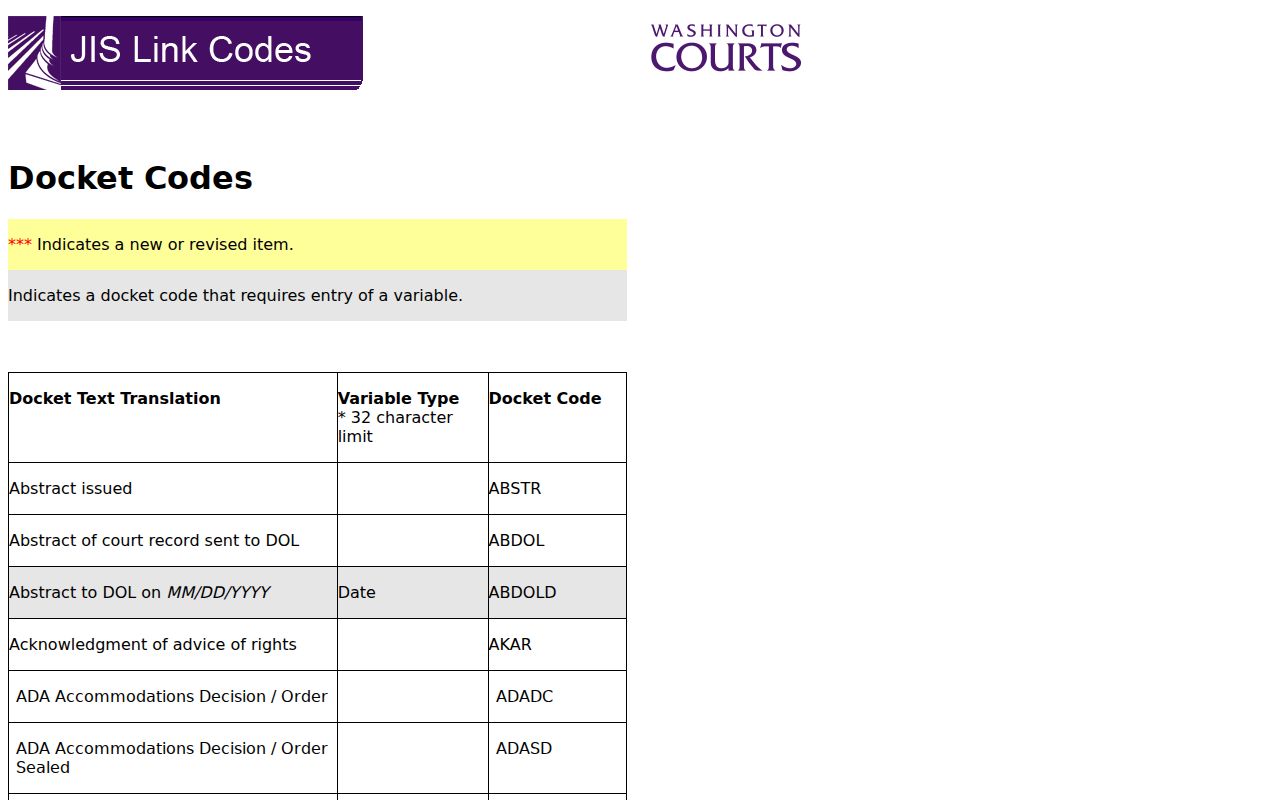
The catalog supplies Washington system vocabulary, not proof of what happened in a particular case. If an entry is disputed, confirm it with the local clerk and the filed order.
- ARR
- Washington JIS hearing code for arraignment, when the court advises the charge and takes a plea.
- PTR
- Washington JIS pre-trial code for a criminal matter after a not-guilty plea.
- BAILST
- Washington JIS docket-entry code for bail set. Read the bail order for actual terms.
- CONTD
- Washington JIS entry for a continued matter. Check the newest setting for the current date.
Stages of a Washington Criminal Case
A Washington criminal case may open with a complaint, information, or indictment. A limited-court file can record probable cause in a felony matter. Prosecution then moves ahead in Superior Court after filing or bind-over. A misdemeanor can begin and remain in District or Municipal Court. Along the way, each Washington court adds its own hearings, motions, rulings, and orders. These go into the docket it keeps.
Docket flow: Charges Filed › Arraignment › Pretrial › Plea or Trial › Disposition › Sentencing
These labels describe common Washington stages, not a fixed order or a statewide code list. Some cases resolve early. Others run through several settings, motions, or continuances. Washington criminal rules set time-for-trial and arraignment clocks, with defined start points, exceptions, and excluded periods. A docket date alone does not calculate those deadlines. When a deadline may affect a case, read the rule and ask counsel or the court about the record.
Two Washington Dockets for Felonies
One Washington felony can touch two courts. A District Court docket may show a preliminary appearance or a felony-complaint status entry first. Prosecution then moves to Superior Court. That new court opens its own case number and its own docket. A bind-over or new charging document marks the shift. It does not erase the earlier limited-court record, though. Check JIS codes as you trace it. FCS means Felony Complaint Status. BOO marks a bind-over order. Local public text sometimes spells the event out in plain words.
When a case looks like it stopped in one portal, the next Washington court may simply have it now. Keep both cause numbers. Superior Court will not repeat each lower-court entry. So ask each clerk for the file it holds rather than assuming one register covers all.
Note: Keep the Washington case number from each court when requesting a record. Transfer does not merge the two registers into one file.
Where Washington Criminal Dockets Sit
Different Washington clerks hold different criminal dockets. The Washington County Clerk keeps the official Superior Court file, felonies included. District and Municipal Court clerks keep their own misdemeanor dockets. A city-ordinance charge can land in a different courtroom than a state-law misdemeanor. After an appeal, appellate clerks open a separate record; the trial docket stays distinct.
For a statewide docket search, Washington Courts Case Search reaches public cases across court levels. The Washington Odyssey Portal covers 37 Superior Court counties. It does not cover King or Pierce Superior Court. King County posts cases on its Clerk records portal, while Pierce County uses LINX. District and Municipal courts take a separate route. Search the venue named on your notice or case papers. If the right clerk is unclear, the Washington county directory and the official Washington Court Directory will sort it out.
When a Washington Criminal Search Fails
A blank Washington Courts Case Search result proves very little. No criminal case is not the same as no result. Washington juvenile offender data never appear in the public statewide index. Sealed files, older files, and locally held files may need a search straight through the court itself. Before calling a search complete, confirm the name spelling and exact case number. Pick the right Washington court level. Check the filing year and case type too.
Still nothing? Use the Washington court named on the notice, or search its local portal. You can also call its clerk. A Superior Court file may sit in Odyssey or another county system. District and Municipal Court dockets run on separate tools. Washington JIS-Link is a subscription display service, not a document repository. For juvenile or restricted cases, ask the clerk which rule applies. The county directory routes you to local information, and the clerk can say whether a public index entry exists at all.
Note: A missing Washington public result can reflect a coverage limit, a protected case, or a different court level. It does not mean the official file is missing.
Sealed Criminal Dockets in Washington
Most Washington court records are open under General Rule 31. State statutes, court rules, and sealing orders can narrow that access. Juvenile offender records carry special limits under RCW 13.50. They stay out of Washington's public index. A GR 15 order can also restrict criminal details. Finding a case in a public Washington docket search does not open every attached document.
Washington access rules:
GR 31, Access to Court Records, sets public access to court records and provides for free courthouse viewing.
GR 15, Destruction, Sealing, and Redaction, requires written findings and favors redaction when it can protect the interest at issue.
RCW 13.50 governs confidentiality, access, sealing, and destruction of juvenile records.
GR 22 limits access to specified protected information in family and related court records.
Note: Court-record rules govern case-file access; the Washington Public Records Act is a separate route for administrative agency records.
Washington Sealing Leaves Index Clues
Sealing does not always scrub a Washington criminal record from the public index. If the whole file is sealed, GR 15 generally permits a limited Washington index entry. That entry carries the case number, party names, case type, and a sealed notation, unless another law protects the case itself. When only one document is sealed, the docket may keep its date and title. The image stays blocked. A reader can see that an event exists without seeing the protected content.
A Washington judge must put findings in writing. Those findings must show a privacy or safety interest outweighs public access. A joint request from both parties alone is not enough. Redaction comes first when it can protect the interest without sealing the full file. Juvenile statutes set their own conditions. For Washington access questions, contact the court holding the record and ask which rule, statute, or order applies. Never infer an outcome from a restricted attachment or a short index entry.
Note: A Washington clerk can explain the access process. Only the court can change a sealing order or decide a contested request.