
Washington Traffic Court Records
Traffic matters in Washington split into two tracks. Civil infractions are the common kind. Washington District Courts and Municipal Courts handle most of them. A citation written by a city usually goes to that city's Municipal Court when one exists. County, highway, and state-law citations typically land in District Court instead. The notice of infraction names the court and explains how to respond. That court name becomes your main locator for the Washington citation docket.
Criminal charges work differently. A Washington misdemeanor such as driving under the influence or driving while suspended opens a criminal docket. It does not create the record class a civil infraction does. Felony conduct belongs in Washington Superior Court. Appeals from a limited-jurisdiction court travel a separate route. They go through Superior Court under the applicable Washington appeal rules. Check the case type printed on the notice to know which court record to seek.
Washington Citation Search Uses Court Name
Washington offers no public statewide lookup by citation number. The public Washington Courts Case Search does include traffic case types. But the lower-court form wants a court plus a name, case number, or business name. There is no citation-number field. Give the citation number to the issuing court instead. Ask that court to pull the local docket.
On the statewide form, pick District and Municipal Courts. Choose the named court, then select a case type like Infraction Traffic or Criminal Traffic. Which filing-year and name or case-number fields you need depends on the search path. The Washington Courts Case Search form locates cases. But it is not a full document service and does not guarantee an index of every local event.
| Court name | Select the District or Municipal Court shown on the ticket or notice. |
|---|---|
| Search type | Name, case number, or business name; the available fields depend on the selected path. |
| Case type | Options include Infraction Traffic and Criminal Traffic, which are different case classes. |
| Year filed | Use the filing-year selector when required by the form. |
| Citation number | No public citation-number field appears on the statewide form; give it to the local clerk. |
Washington Citation and License-Hold Systems
Washington runs several traffic tools, and each one holds something different. The public case index locates court cases. Find My Court Date lists future lower-court appearances. Your local Washington District or Municipal Court keeps the citation docket and any response. The Washington Department of Licensing (DOL) handles license consequences a court reports. DIAS supports restricted government workflows.
| System | What it holds | Run by / access |
|---|---|---|
| Washington Courts Case Search | Public case index with traffic and criminal traffic case types | AOC / JIS; public search |
| Find My Court Date | Future District and Municipal Court settings | AOC; public court and name search |
| Local District / Municipal portal | Official citation docket, response, hearing, and disposition | Issuing court; tools vary by court |
| JIS-Link | Display-only data for courts connected to JIS; no document images | AOC; subscription access |
| DOL Unresolved Traffic Citations (UTC) | License suspension or reinstatement consequences reported by a court | DOL; personal License Express account, not a public ticket search |
| DOL license record | License status and driving information reported under law | Department of Licensing; a separate agency record |
| DOL DIAS | Government court workflows for UTCs and reported case outcomes | DOL; restricted court and government users |
The Washington DOL table entries describe agency systems rather than an extra court docket. DOL keeps license information apart from the Washington court's citation file. Its Washington Driver and Plate Search and DIAS information page explains the restricted adjudication tools that courts and government users work with.
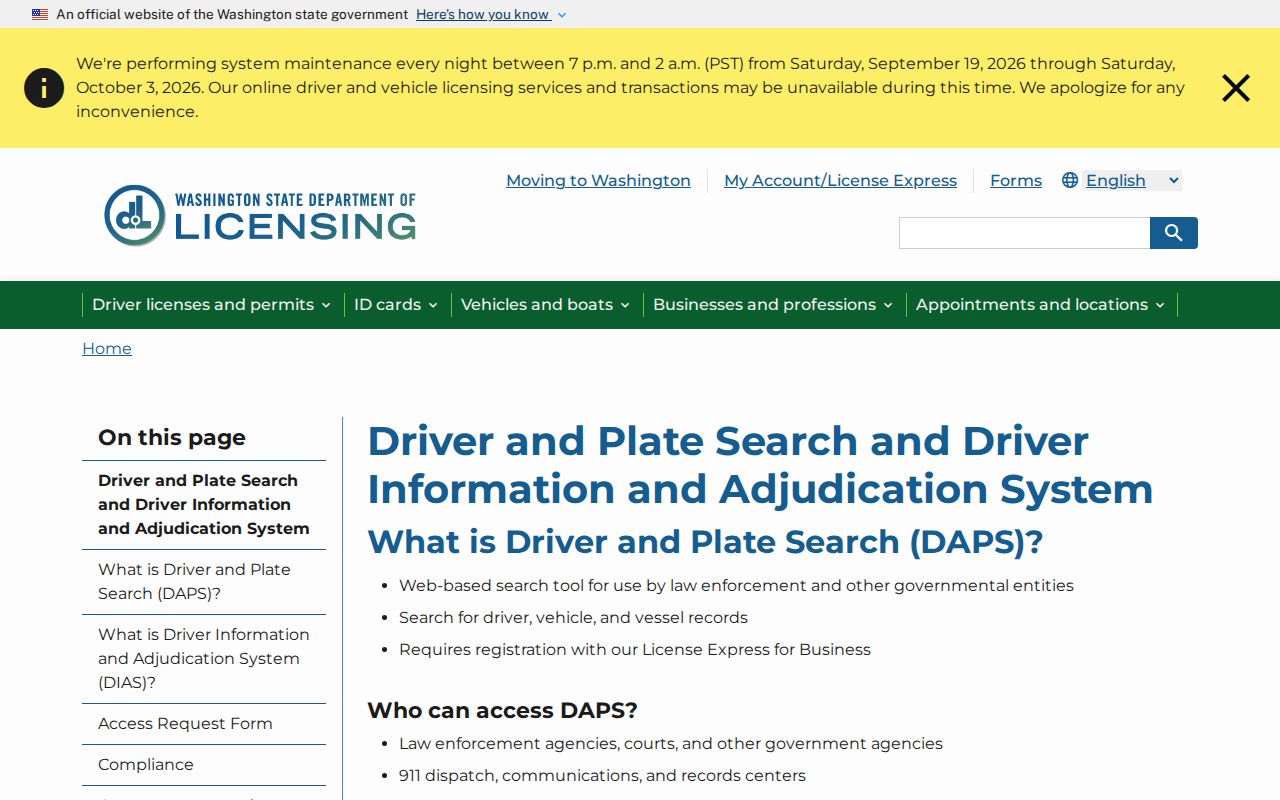
That DOL screen maps a government workflow. It is not a public ticket lookup or a driver-record service from this hub. The Washington court holds the citation file, while DOL handles license consequences reported under law.
Note: A Washington DOL notice can identify license consequences. But only the court can confirm the citation's judicial status.
The Washington DOL UTC Is Not a Case Search
Washington DOL calls a license suspension tied to certain unresolved moving citations an Unresolved Traffic Citation (UTC). A hold can follow a court's report of failure to respond, appear, or meet specified terms. "Failure to appear or pay" is not a public case-search product. Washington also posts no public roster of license holds. The Washington DOL UTC page explains the program and the court-to-DOL clearing path. The official Washington Court Directory lists local court contacts.
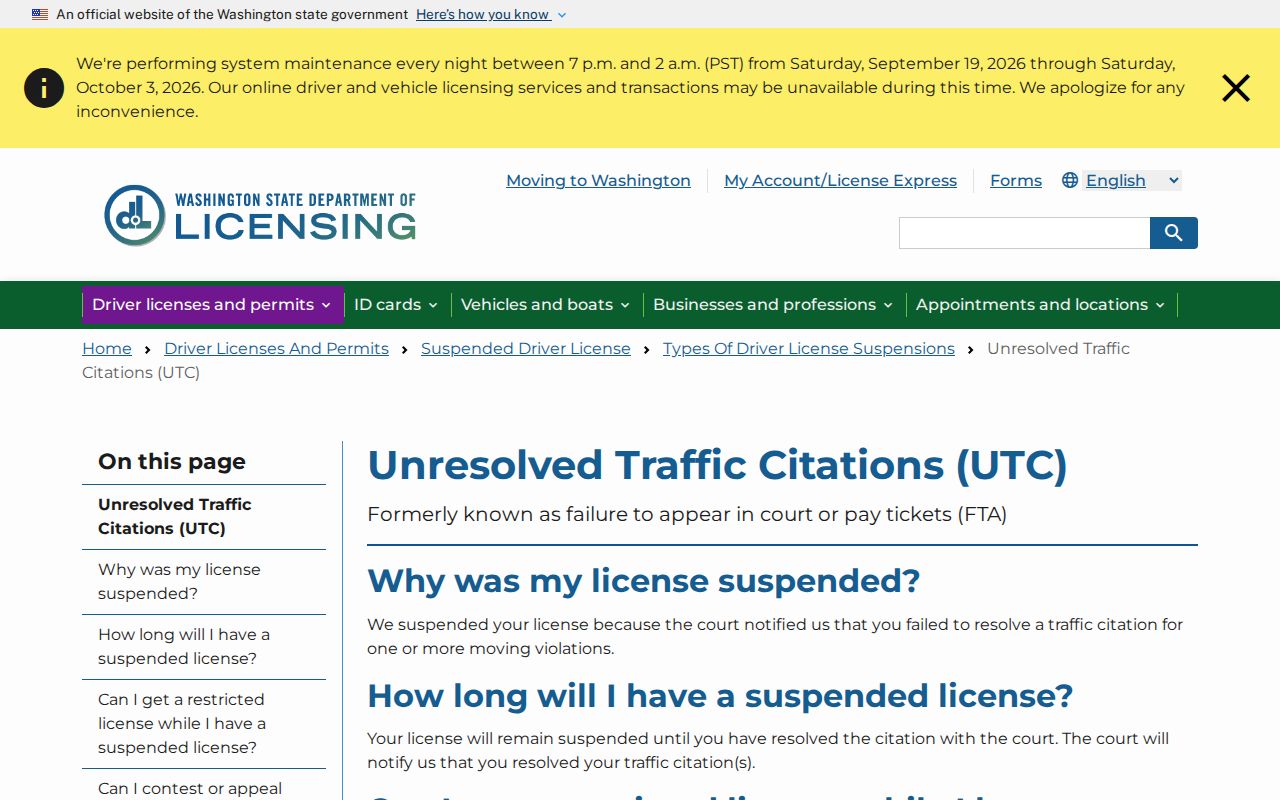
The DOL material covers license status and reinstatement steps. It does not cover the local court's citation file or any public ticket-number lookup. Settle the judicial status with the court named on the notice.
Under Washington RCW 46.20.289, DOL may suspend a license after a court notice about specified unresolved moving violations. Statutory exceptions apply. Once the matter is resolved, the court reports the outcome to DOL. License status then gets updated. A DOL letter can flag a hold. But the Washington court still controls the citation docket.
Looking Up a Washington Traffic Ticket
Begin with the court printed on the Washington ticket rather than guessing which county or city issued it. Keep the citation number handy, plus any assigned case number and the name shown on the notice. A statewide index can locate a public case, but the local court stays the official source for the response and final disposition.
- Read the Washington Court Name and response instructions on the citation or notice.
- Use Washington Courts Case Search with the court, Washington traffic case type, and required name or case number.
- For a future Washington District or Municipal Court date, use Find My Court Date with the court and first and last name.
- If no result appears, use the Washington county directory to reach local court information, then ask the court clerk to search by citation number.
- Check the latest court notice or order for the current date, response path, and disposition.
A Washington search result never replaces the notice deadline or the court's current instructions. Where you pay, whether an online option exists, any card fee, and local forms can all differ by Washington court. When a citation appears in more than one system, trust the issuing court docket to confirm the response.
Find a Washington Traffic Hearing Date
Washington Courts runs a Find My Court Date tool. It covers upcoming appearances in District and Municipal Courts. Pick the court first. Then type the first and last names exactly as they appear on the court papers. Complete the CAPTCHA and submit. There is no case-number field and no date-range option. The tool returns no documents either. It is not a posted daily calendar.
A hearing should be on the calendar soon. Use the official Washington Find My Court Date search. A missing date, or one that may have moved, calls for a later local court notice. Follow that with a phone call using the court's own listing. The statewide result may also leave out a Superior Court setting. In that situation, go to that court's case register or calendar instead.
Note: An older date may still show in a Washington calendar or register. The newest order or notice and direct confirmation from the court control.
Paying or Fighting a Washington Ticket
Got a Washington traffic infraction notice? RCW 46.63.070 gives you 30 days from the notice date to respond. Pay it, request a contested hearing, or request a mitigation hearing. Contesting means disputing that the infraction occurred. Mitigation asks the Washington court to weigh circumstances without contesting it. The ticket itself names the court. That court receives your response.
| Paying the infraction | Contesting the infraction |
|---|---|
| Submit the Washington notice section and penalty to the named court, unless using an available inability-to-pay option. | Request a contested hearing from the court; it sends written notice of the hearing date. |
| The Washington court records an order and reports information to DOL as required. | The court sets a hearing so the violation can be contested. |
| Follow the Washington notice’s 30-day response period. | Respond within the same Washington statutory period; check the court notice for hearing details. |
Unresolved moving citation: If a person does not respond or appear on a moving-violation matter, the court may notify DOL under the law. That can lead to a license suspension; resolve the citation with the court that holds the case, then confirm the license status with DOL.
Note: Payment methods and forms differ among Washington courts, so follow the instructions on the citation when you respond.
Washington Mitigation and Deferred Findings
You can ask a Washington court to mitigate an infraction. This does not argue over whether it happened. A court can also defer a finding. It can defer an order after mitigation, for up to one year under RCW 46.63.070. Meet the conditions. Avoid any other infraction during the deferral period. The court may then dismiss the matter. A docket can show a deferral entry followed later by a dismissal.
Washington law puts limits on this relief. A moving-violation deferral is generally allowed once every seven years, and a nonmoving deferral once every seven years as well. Certain commercial-driver situations and some vulnerable-user negligent-driving cases are excluded. Courts may assess administrative processing costs, and local payment and hearing procedures vary. The exact wording of the outcome lives in the local court record. Rely on the clerk's entry or order, and do not assume every Washington portal uses the same label.
- Contested hearing
- A hearing to dispute whether an infraction was committed.
- Mitigation hearing
- A request to explain circumstances without contesting the violation.
- Deferred finding
- A court defers the finding under conditions and may dismiss if those conditions are met.
Washington Court Record vs Driver Record
One Washington traffic ticket can touch two separate records. The District or Municipal Court keeps the citation case itself: the response, the hearing, the order, and the final result. DOL keeps license status plus whatever gets reported to it, such as suspensions and qualifying conviction data. Each office answers for its own record. The court speaks for what happened in its case. DOL speaks for your license.
| Record point | Court traffic record | DOL driver record |
|---|---|---|
| Custodian | Washington District or Municipal Court Clerk | Washington Department of Licensing |
| What it reflects | Citation, response, hearings, orders, and disposition | License status and information reported under law |
| Where status is confirmed | The Washington court named on the ticket or its official local portal | DOL agency correspondence |
| What it cannot replace | It does not by itself confirm that DOL has updated a license status | It is not a Washington citation docket or substitute for the court file |
A DOL driver record and a Washington court file are separate things. They can also update at different times, so ask each office about its own record.
Note: Washington court and DOL records answer different questions; confirm each status with the office that maintains it.
Washington Photo Citations Stay Local
Washington law allows automated traffic safety cameras for defined purposes, including red-light, school-zone, work-zone, transit, and other legislatively listed locations. A camera notice is generally handled as a Washington civil traffic infraction. The notice names the issuing city or county. It also names the court that owns the citation. Camera tickets do not get their own statewide citation search. Not every camera system feeds the same portal either.
Take the court name printed on the Washington notice. Search that local docket, even when the citation started with a camera. RCW 46.63.075 and the camera provisions in RCW 46.63.220 set Washington's requirements. Case-specific response and hearing details come from the issuing court. A criminal traffic charge, by contrast, follows a criminal docket. It has its own case type. The statewide index may not resolve a citation. Then the Washington county directory routes you to local court information.