
Searching Civil Dockets in Washington
Washington Courts Case Search is the statewide index for public cases. Pick a court level, a civil case type, and a case number or party name. That choice matters. A Washington civil claim may sit in Superior, District, or Municipal Court. A hit does not guarantee a full history or document copies. The number printed on a notice or pleading is often the best match for the local register. For broader steps, see the Washington case lookup.
There is no single portal for all Washington civil records. Odyssey serves 37 Superior Court counties. The rest rely on local systems and separate lower-court searches. The court clerk keeps the official file. The clerk can track down a missing event or paper. Find the venue on the case papers. Then use the Washington county directory to reach the local court layer.
- Read the case number, Washington court, and case type from the summons or order.
- In Washington Courts Case Search, choose the court level and civil case type shown by the file.
- Search the exact case number or the party name, then check the court and filing details in the result.
- If the Washington index is brief or has no match, use the local court channel or county directory.
- Ask the record custodian for the complaint, order, judgment, or certified copy you need.
Treat these as two related searches. A Washington case may show in the index while the filed pleading is only available from the local court.
Washington Civil Search Channels
No single register covers every Washington court, so civil docket searches run through several channels. The statewide index lists public cases. Odyssey offers a fuller Register of Actions for participating Superior Courts. Local systems cover courts outside that group. King and Pierce Washington Superior Court records sit on separate county portals. JIS-Link can display data for connected lower courts.
The official Odyssey Portal is one Washington local-register channel. The Washington Courts JIS-Link access page describes a fee-based subscription. It covers display-only case and docket data for connected courts.
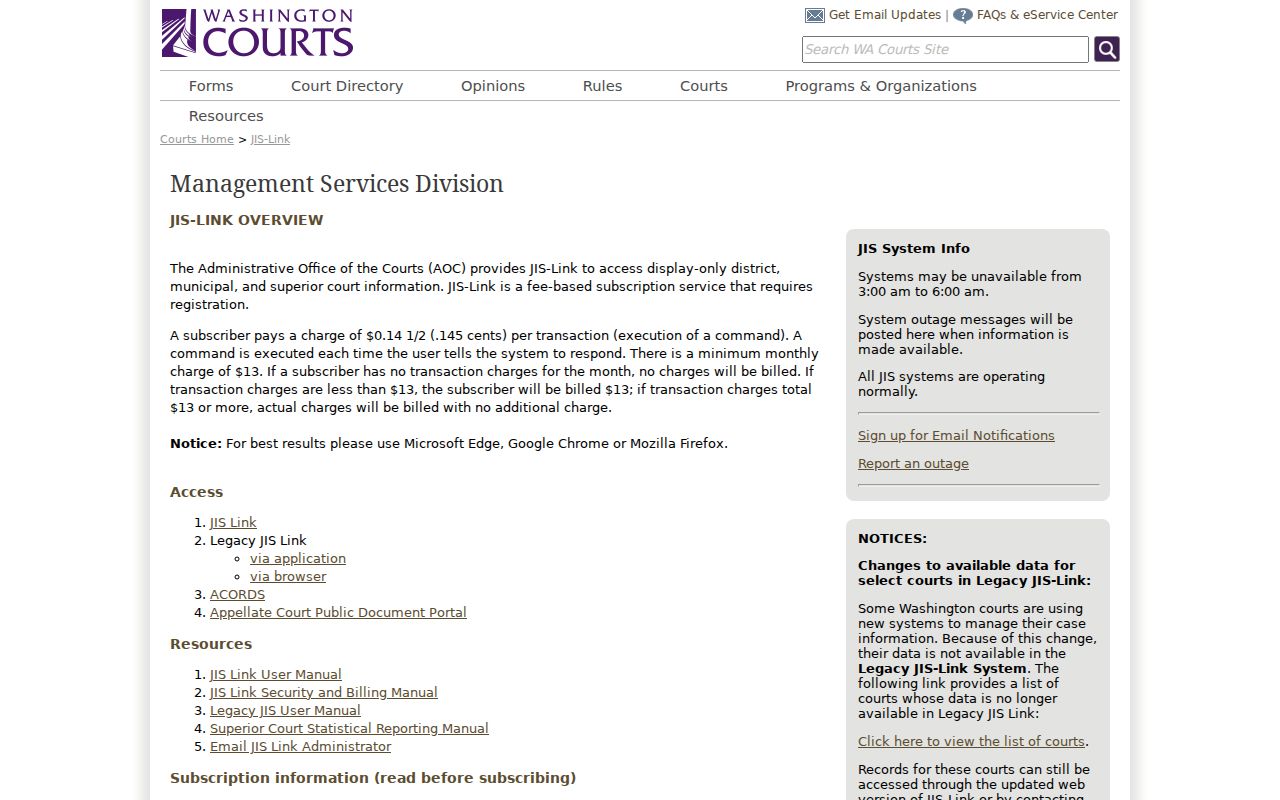
This Washington Courts page spells out JIS-Link subscription and billing terms. The service shows connected-court data without filed-document images, so ask the Washington court clerk for pleadings, orders, and authoritative copies.
| Washington search channel | What it can show | Next route |
|---|---|---|
| Washington Courts Case Search | Statewide case locator and selected public case details | Local register or clerk for full events and documents |
| Washington Odyssey Portal | Superior Court Register of Actions in participating counties | Local Clerk for access, documents, and fees |
| King County Clerk portal | Separate Superior Court case and record channel | King County Clerk |
| Pierce County LINX | Separate Superior Court case and record channel | Pierce County Clerk |
| Washington District / Municipal Court | Local limited-jurisdiction register; JIS-Link can display connected-court data | District or Municipal Court Clerk |
What a Washington Civil Docket Shows
A Washington civil docket can list a case number, court location, filed date, case type, party names and roles, events, settings, disposition entries, and any documents the local system releases. Washington Odyssey labels its sections Case Information, Party, Disposition Events, Events and Hearings, Register of Actions, and Documents. Case type 2 means Civil. That code is not a statewide case-number format.
| Case number | Washington court identifier. Keep it with the court name when searching or requesting a file. |
|---|---|
| Parties and roles | Party names may appear in the Washington case record; captions and counsel details vary by portal. |
| Filings and events | Washington chronology may point to a complaint, response, motion, order, or judgment. The event is not its document. |
| Settings | Local records may show date, time, courtroom, or event type. The Washington index is not a complete calendar. |
| Disposition | Washington status or judgment fields may appear; verify the result against the signed order or judgment. |
A short result is not the whole claim or the court's full ruling. The complaint states what relief a party sought; an order or judgment states what the court decided. Washington Courts Case Search does not supply outcomes. A clerk-certified copy differs from a portal view.
Washington Civil Events and Filed Orders
A docket entry indexes activity in a Washington civil case. "Judgment entered" points to a court action, and the judgment document gives its terms. A hearing notice shows a date, not a ruling. A status or disposition code depends on its field. Washington JIS materials use different meanings for DP and DW in case-disposition and civil-judgment tables.
Use the event to find the paper. Then read the Washington order or judgment before drawing any conclusion. Odyssey and local dockets may show an event without its document. District Court JIS records separate case disposition, judgment type, ruling, and judgment disposition. "Satisfied" is not the signed judgment. Keep the event, the document, and the legal result distinct.
- Disposition
- A Washington case’s recorded procedural outcome; confirm its meaning in the local file.
- Judgment
- The Washington court’s formal decision, separate from the docket line noting entry.
- Default judgment
- A civil judgment entered after a party does not respond or appear as required.
- Nonsuit
- A plaintiff’s voluntary dismissal of a claim, subject to applicable rules and costs.
Note: For an exact Washington civil result, request the filed paper by case number and document name or date, not just the event label.
Civil Case Types on Washington Dockets
Washington sorts civil cases by issue, requested remedy, and court authority. Superior Court handles general civil claims, family and domestic relations, probate, and real-property title or possession. District Court hears specified civil claims and small claims. A Municipal Court may handle limited local civil or infraction matters. An appeal creates a separate appellate case record. A "civil" label in a search result does not by itself tell you which court holds the full file.
| Case or issue | Likely Washington court level | Record clue |
|---|---|---|
| General civil, family, probate, real-property title | Washington Superior Court | County Clerk keeps the official file |
| Specified lower-value civil claim | Washington District Court | Check the statutory claim type and limit |
| Small claim | Washington District Court small-claims department | Separate small-claims route and judgment fields |
| Local civil infraction | Washington Municipal or District Court | Use the court named on the notice |
| Small-claims appeal | Washington Superior Court | A later cause may have its own docket |
Family and probate cases are civil court matters, yet some attached papers carry special access limits. Land title and possession claims also follow different authority than a simple money demand. Identify Washington's court level from the case papers and statute, not from a broad portal label.
Washington Small Claims Limits
Money limits decide where a Washington civil case belongs. They work differently at each level. District Court can hear certain civil claims up to $100,000 under RCW 3.66.020. The dollar figure alone does not get a case there. The statute lists the qualifying actions. The claim type matters as much as the amount. Small claims sit under a separate cap: RCW 12.40.010 sets the ceiling at $10,000 for a natural person and $5,000 for anyone else.
Want to appeal a Washington small-claims judgment? File the notice in District Court within 30 days. The route can involve Superior Court filing and record-preparation fees. A bond or undertaking may be required unless a statutory exception applies, along with service; RCW 12.36.020 walks through the steps. Hold onto the trial number and any Superior Court number the appeal picks up.
Note: A dollar amount is only one venue clue in Washington. The claim type and requested relief can matter just as much.
Washington Civil Settings and Hearings
A Washington civil docket usually mixes hearings with filings, motions, and orders. Depending on the court, the local portal may list the date, time, room, hearing type, or judicial officer. The fields vary. Odyssey Search Hearings covers participating Washington Superior Court systems. No single statewide label set for civil settings is published.
Always weigh the newest Washington setting against the current court notice. An older motion date can linger after a reset. The entry shows a scheduled event, not proof it happened or that the court ruled. When a date matters to a case, read the latest order. Ask the clerk or coordinator which notice controls.
Washington Civil Case Search Fallbacks
A Washington civil case missing from the statewide search is not lost. Start with the court and number printed on the paper. Confirm the court level and civil type. The register may live in Odyssey, a separate county portal, or a District Court search. It may also sit in the clerk's own system. Appeals add a wrinkle: a second cause number may exist.
The Washington county directory points to the local layer. The court clerk confirms whether a file exists and who keeps it. For court contacts, the official Washington Court Directory is the reference. Give the clerk the Washington case number, party names, filing date, and the document you need. JIS-Link displays data for connected courts but carries no document images. If the online docket search comes up short, ask for the docket or paper by title or date.
Note: A Washington state index result can help locate the court. The local clerk remains the source for a filed civil document.
Washington Civil Docket Access
Openness is the default for Washington court records under GR 31. A statute, rule, case law, or order can still limit access. Viewing a Washington file at the courthouse is free. Copies are another matter: paper, electronic, and certified versions can cost money. The Washington Public Records Act, chapter 42.56 RCW, governs state and local agency records. It does not govern ordinary filed case records. Administrative records follow the separate procedure in GR 31.1.
Washington court-record rules:
Washington GR 31 governs public access to court case records and courthouse viewing.
Washington GR 15 sets procedures for destruction, sealing, and redaction of court records.
Washington GR 22 restricts listed personal, financial, health, and family-related materials.
RCW 42.56 is the general Public Records Act, not the ordinary rule for a court case file.
A civil case caption on a Washington docket may look open, but that does not make every attachment public. Sealed filings and limited-access records sit inside many case files. Ask the Superior Court Clerk, District Court Clerk, or Municipal Court Clerk holding the file which record class can be viewed or copied.
Washington Civil Records and Attachments
A Washington civil docket can stay visible even when a linked document is protected. GR 22 lists confidential financial source papers. It also covers health-care records, personal-information sheets, reports, and some protection-order materials. It does not make every Washington family case secret. A public entry can sit beside a restricted attachment. The rule text names the protected record classes.
GR 15 draws its own line between sealing a whole case and restricting selected papers. Redaction can shield one sensitive part without sealing every record. When required, the judge must make written findings. For a Washington family, probate, or other civil file, ask the clerk which document and rule control. A case number alone never decides access.
Note: A Washington public event line can remain while the linked paper is withheld under a rule or court order. The restriction, not the docket, is what the court orders.